The guide’s working idea
There is no permanent best build. Boss encounters and platforming stages ask different questions, so a useful choice is the one that suits the opening, your comfort, and the timing you can actually maintain.
01 / Loadout Desk
This Cuphead Arcade field guide looks at Cuphead’s run-and-gun gameplay through the choices surrounding it: a shot changes your attack spacing, a charm changes a trade-off, and movement decides whether either choice can be used safely. It is an informational review guide, built for players who want a clearer way to approach the game’s demanding rhythm.
There is no permanent best build. Boss encounters and platforming stages ask different questions, so a useful choice is the one that suits the opening, your comfort, and the timing you can actually maintain.
Follow the trail from weapons and charms to practical selection logic, Run ’n Gun movement habits, and calm ways to learn one attempt at a time.
02 / Four Parts
Think of a combat loadout as a small set of decisions that changes how an encounter feels. The pieces work together, but each deserves its own question: what space does this ask me to occupy, when should I spend meter, and which trade-off helps with the problem in front of me?
Your selected weapon chiefly changes range, coverage, damage feel, and the attention needed to aim it. Rather than chase a ranking, learn its rhythm and the space it asks you to hold. A shot that feels comfortable can leave more attention for reading a boss’s movement and recognising a safe opening.
Special meter can be spent on an EX move, creating a stronger burst option when an opening appears. The useful question is often not whether meter is available, but whether the moment is safe enough to commit. In crowded sequences, patient timing can matter more than immediate spectacle.
A Super Art is a larger meter-driven decision during longer encounters. It can change when you choose to commit, but it does not need to become a mandatory answer. Consider reliability first: choose an option whose timing and use feel understandable while you are still learning the pattern.
A charm can solve one kind of problem without erasing the need to learn the encounter. These modifiers may support survival, mobility, parrying, or another play preference, but selecting one means leaving another useful benefit behind. That trade-off is the point: choose for the stage need, then test it deliberately.
03 / Combat Spacing
Weapon choice influences more than what reaches the target. It changes where you stand, how much of the screen you must watch, and how much attention remains for a boss encounter’s movement. Treat a new shot as a positioning experiment before treating it as a verdict on damage.
A longer-reaching or more direct shot can feel safer when distance is available, while another option may ask for closer positioning or more deliberate placement. Neither approach wins by default. Watch where the boss moves, where your safe lanes appear, and whether the encounter gives you enough time to use the spacing the shot prefers.
Some attack styles help fill an area; others reward concentrating attention on where a target is likely to be. Coverage can feel reassuring on a busy screen, while focus can suit predictable openings. Let the encounter’s motion decide which kind of attention makes more sense, rather than expecting one approach to solve every phase.
Choose the shot that leaves room to survive the pattern. Preference can depend on how much thought must go into dodging, parrying, and reading what comes next. A setup that lowers your aiming burden may be a sound learning strategy when movement is the harder task, not a shortcut around it.
04 / Backstage Board
A charm is most useful when it answers a specific friction point: survivability, movement confidence, parry comfort, or consistency under pressure. Before swapping equipment, name what is ending the attempt. That small diagnosis makes experimentation feel like progress, because each choice has a clear reason behind it.
Trade-off stamp
Selecting one helpful modifier means leaving another benefit behind. The goal is not universal optimisation; it is fit. A choice that suits your timing and the stage’s immediate need can be more useful than a popular option that asks you to play in a way that feels unreliable.
01 Make one change. 02 Play a few focused attempts. 03 Ask whether the hardest recurring moment became more manageable. Avoid replacing every part of a setup at once. Repeated attempts are observation, not failure, and a smaller experiment is easier to read.
05 / Side-Scroll Stage
Run ’n Gun stages ask players to travel through hazards and enemies while managing movement and attacks. That creates a different kind of pressure from a focused boss arena: you must observe terrain and threats ahead while still preserving enough attention for the next jump, dodge, or route choice.
Run ’n Gun
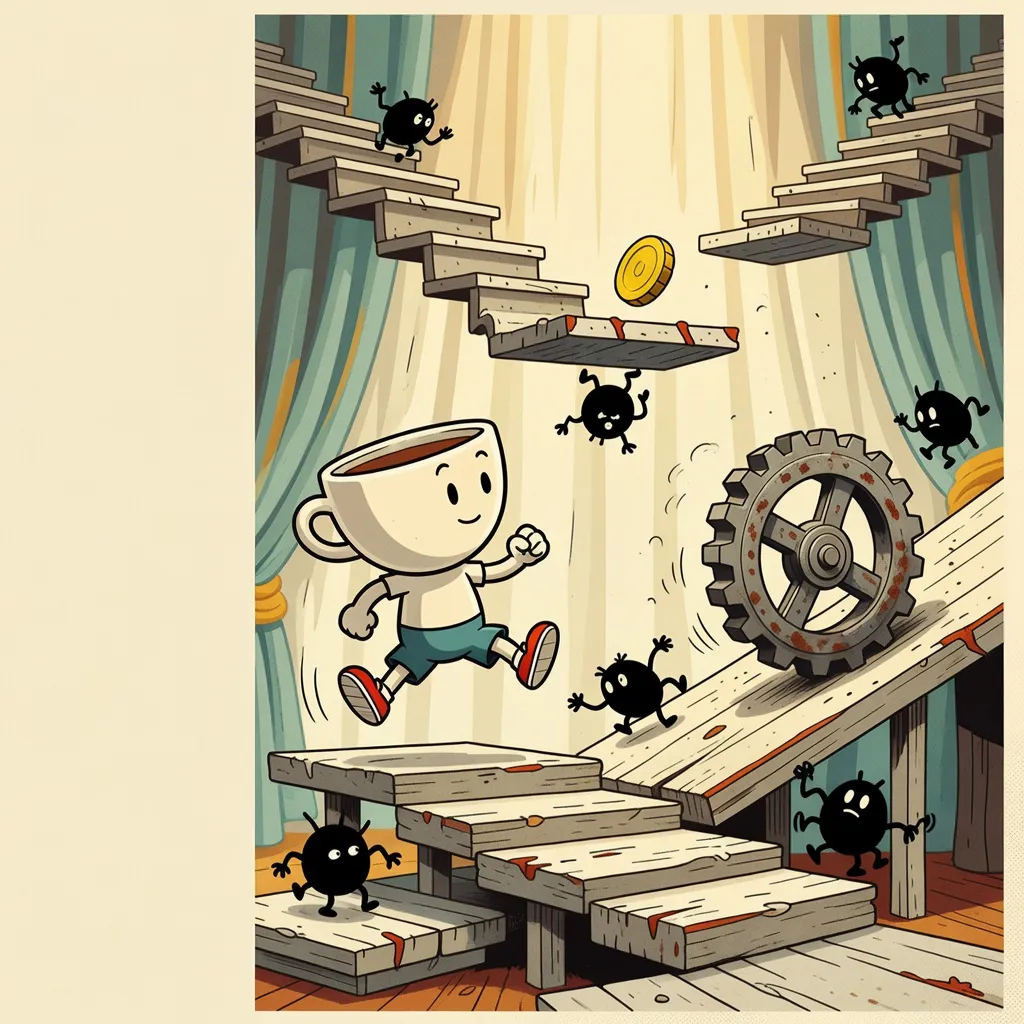
Use brief pauses in action to recognise enemy placement, hazards, and the safest route through a screen. Anticipation is more useful than rushing: a little forethought can preserve the attention needed for the jump or dodge that follows.
Successful platforming often comes from recognising repeatable movement beats and resisting panic inputs when a sequence becomes crowded. Retried sections can reveal a steadier rhythm, which is part of the game’s arcade-like appeal.
Run ’n Gun stages include coins, giving careful exploration a practical reason to look beyond the most obvious route. Collection still asks for safe movement, so revisiting a route after learning it can feel more measured than forcing every discovery on a first pass.
06 / Practice Sheet
Use these habits as small priorities, not a checklist to perfect all at once.
Prioritise where you will land, especially when an attack opportunity competes with a jump or dodge. Safe movement is the foundation for sustained damage. If the landing is uncertain, protecting that space may matter more than squeezing in one more moment of offence.
Use early passes to understand a route, then return for coins or more ambitious paths once movement feels familiar. This lower-pressure approach lets you learn the stage without demanding that every first look also becomes a perfect collection attempt.
A recurring obstacle reveals something to observe: timing, route, spacing, or a moment where restraint helps. Restarting is normal in a challenging game. Try one adjustment, then watch whether that hazard becomes clearer instead of asking the whole run to change at once.
Do not commit every moment to offence. A stage can require repositioning, jumps, and reactions to incoming threats. Leave recovery space in your plan, then connect that need back to weapon aiming load and charm choice when a setup repeatedly feels too demanding.
07 / Field Manual
Identify the immediate barrier. Is it keeping distance, surviving a crowded sequence, managing movement, or capitalising on brief openings? These are examples, not fixed labels. Specificity gives a loadout change a purpose and stops a difficult attempt from becoming one vague complaint.
Adjust a weapon or charm with a clear reason instead of rebuilding every part of a setup after each loss. One useful variable makes cause and effect easier to notice. It also keeps the next few attempts focused on learning rather than on remembering a completely new plan.
A better setup may make one hard moment more repeatable before it produces an immediate victory. Observe positioning, survival, and confidence through the sequence. That is enough evidence to decide whether the change deserves more time or whether another small experiment is needed.
Use these questions to keep experimentation intentional rather than automatic.
08 / New Player Reading
Newcomers do not need to master every system at once. Start by reading movement, then test a weapon or charm choice with a clear purpose. This layered approach keeps the game’s weapons, charms, platforming challenges, and difficulty from arriving as one overwhelming lesson.
Cuphead’s demanding arcade-like pace is likely to suit players who enjoy observation and retries. Boss encounters and movement sequences can feel intense, and they will not suit every preference. For others, gradual consistency is precisely what gives each cleared pattern its satisfaction.
System character
Weapons and charms make progress feel less like a fixed script because players can choose a toolset that fits the challenge currently being studied. That flexibility does not guarantee success, but it gives each careful adjustment a meaningful place in the learning process.
Ready to continue? Use the search action below if you want to look for Cuphead on Google Play.
09 / Search Ticket
Want to continue your search? This ticket opens Google Play search results for Cuphead in a new tab, giving you a direct way to review what is currently returned by the store search.
Find Cuphead on Google PlayThis button opens Google Play search results and is not a confirmed official Cuphead listing.
10 / Guide Takeaway
Weapon and charm choices should answer the challenge currently causing difficulty, not chase a universal ranking. A useful setup is one you can understand and maintain during the encounter in front of you.
In Run ’n Gun platforming, route reading, landing awareness, and recovery space remain essential. Let those movement needs guide the amount of aiming and commitment you ask from yourself.
Demanding play becomes more understandable through observation and one deliberate adjustment at a time. Keep the next experiment modest, then give yourself enough attempts to notice what it changes.